The Role of the Bar Counter in the History of Cinema
The bar counter. Iconic, a divider, a lifesaver. An ideal barrier, as well as an architectural one. Some people stay away from it, while others couldn’t sit anywhere else. There are those who love the pub-style one, made of wood, sticky, and swollen with all the beer foam that has accumulated over the years. There are the traditionalists who prefer the marble one, polished and vintage. Then there are those who are nostalgic for the steel one, typical of authentic, unchanged places.
The bar counter has always held a fascination for cinema, which has often made it the protagonist of iconic and unforgettable scenes. In cinema, the bar counter is never just a piece of furniture. It is a psychological frontier, a theatrical dividing line. On one side stands the bartender (the sage or the executioner, the confessor, the guardian of the rules); on the other, the customer (the wanderer, the fugitive, the seeker of answers).
Historically, on the big screen, the most common materials used for the bar counter are wood or marble, which separate two worlds: order from chaos, sobriety from intoxication, fiction from harsh reality.
Today, on RGLife, you’ll find an overview of cinema’s portrayal of the bar counter’s role in the relationship between bartender and customer.

The bar counter in the relationship between bartender and customer
1. The bar as a limbo of the soul: Stanley Kubrick’s The Shining (1980)
Perhaps the most iconic bar counter scene in the history of cinema. Jack Torrance (Jack Nicholson) enters the deserted Gold Room and sits at the bar. Out of nowhere appears Lloyd, the elusive bartender.
The dynamic: in this case, the bar counter serves as both a mirror and a barrier between sanity and madness. Lloyd is icy, detached, impeccable; Jack, on the other hand, is sweaty, desperate, and in search of an ally.
The barrier: the bar counter separates the world of the living (Jack, or what remains of him) from the spirit world of the Overlook Hotel. It is a profane confessional, where Jack sells his soul for a glass of bourbon. Kubrick frames the bar with hypnotic symmetry, turning it into an insurmountable geometric barrier.
2. The Trench of Brutal Honesty: Casablanca (1942) by Michael Curtiz
At Rick’s Café Américain, the bar is the fulcrum around which the world’s cynicism revolves. Rick Blaine (Humphrey Bogart) uses it as an emotional shield.
The dynamic: when Rick sits at the bar drinking alone at night, the wood becomes the boundary between his cynical present and his painful past (Ilsa). Bartender Sascha or Rick himself, when serving guests, use the bar counter to establish distance—the only certainty in a transient place filled with spies and desperate souls.
The barrier: here, the bar counter divides the private from the political. On one side, drinks are served; on the other, the fate of lives is decided.

3. The barrier that unites (and deceives): Passengers (2016) by Morten Tyldum
In the cosmic void of a spaceship, the android bartender Arthur (Michael Sheen) is the only point of reference for Jim (Chris Pratt).
The dynamic: the bar’s look is a clear homage to that of The Shining, but the dynamic is reversed. While Jim desperately seeks human warmth, Arthur offers a perfect simulation of algorithmic empathy.
The barrier: the polished bar counter separates the organic from the synthetic, human desperation from robotic programming. As long as Jim remains on the other side of the bar counter, Arthur is the perfect confessor. But when Jim breaks the moral barrier by confessing that he woke Aurora, condemning her to death, the bar counter once again highlights Arthur’s coldness, as he cannot comprehend the ethical weight of that secret (and in fact will reveal it).
4. The Confessional of Solitude: Lost in Translation (2003) by Sofia Coppola
The bar at the Park Hyatt in Tokyo is the quintessential non-place. Bob (Bill Murray) and Charlotte (Scarlett Johansson) take refuge there to escape jet lag and existential alienation.
The dynamic: the bartender is a background figure, a whisky dispenser who speaks another language. In this case, the barrier is not so much between the bartender and the customer, but between the two protagonists and the Japanese context they do not understand.
The barrier: the bar counter acts as a raft, isolating Bob and Charlotte from the noise of the city. Sitting there means declaring one’s status as an ‘outside observer.’ The counter delineates a safe zone, where two solitudes can finally touch precisely because they are protected by that structure.
5. The Trench of Power and Tension: Quentin Tarantino’s Inglourious Basterds (2009)
In the highly tense scene at the underground tavern in Nadine, the bar counter becomes the epicenter of a heart-pounding game of massacre.
The dynamic: the fake German officer, British agent Archie Hicox, and Gestapo Major Hellstrom find themselves face to face. Initially, the bar counter is managed by the tavern owner and the waitress, who try to maintain the illusion of normality by serving drinks.
The barrier: as tension rises, the bar counter becomes a strategic and geopolitical dividing line. On one side are those controlling the space (the Nazis); on the other, those infiltrating it (the spies). Tarantino uses the bar counter and the glasses resting on it as elements of pure suspense (the famous three-finger mistake when ordering drinks), transforming it from an element of conviviality into a line of fire for the weapons hidden beneath it.
6. The Bar Counter as a Mirror of Change: Cocktail (1988) by Roger Donaldson
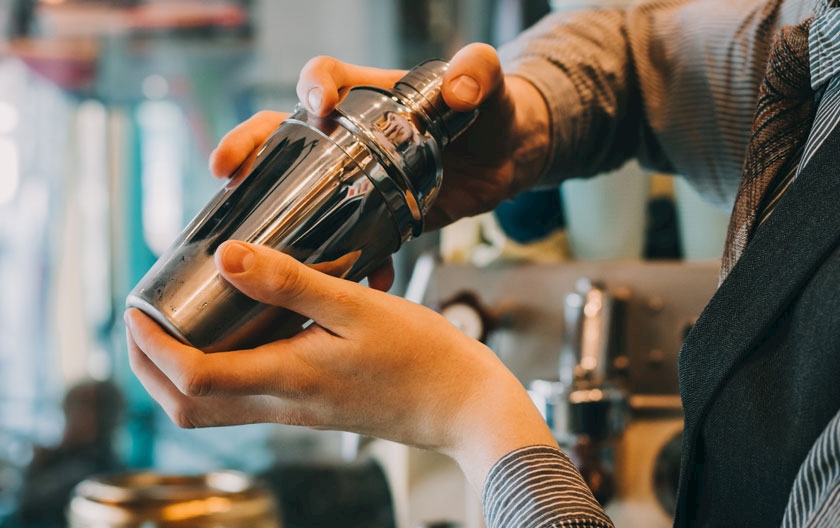
One cannot fail to mention the film that mythologized the figure of the bartender in the 1980s. Brian Flanagan (Tom Cruise) learns the art of flair from his mentor Coughlin.
The dynamic: here, the bartender-customer relationship is purely performative. The bar counter is a stage, where the bartender does not listen but enchants, captivating the customer through his personal show.
The barrier: in this case, the barrier separates the ordinary (the customer watching) from the extraordinary (the bartender performing bottle tricks). It is a barrier of status: those behind the bar control the pace, the alcohol, and the evening; those in front are paying customers waiting to be amazed.

One of the most fascinating dividing lines in the history of cinema
The bar counter in cinema proves to be a formidable narrative device precisely because of its dual nature: it unites the characters in space, yet separates them dramaturgically. It is an architectural barrier that transforms into a moral, social, and psychological barrier. Behind that line lies the transition from the order of those who serve to the chaos of those seeking help, from the pretense of the stage to the vulnerability of confession.
Through the films mentioned, cinema has taught us that, to truly understand a film’s direction and the secrets of its protagonists, it is often enough to look at which side of the bar they choose to sit on.
Ultimately, whether made of solid mahogany in an Old West saloon or polished zinc in a metropolitan noir, the bar remains one of the most fascinating dividing lines in the history of cinema. It is not just a piece of furniture, but a stationary camera that records human comedy and tragedy.
When the lights in the theater dim and the credits begin to roll, the impression is always the same: as long as there is a customer sitting on a stool seeking answers and a bartender on the other side ready to clean yet another glass, cinema will always have a safe place to stage power, destiny, and loneliness.